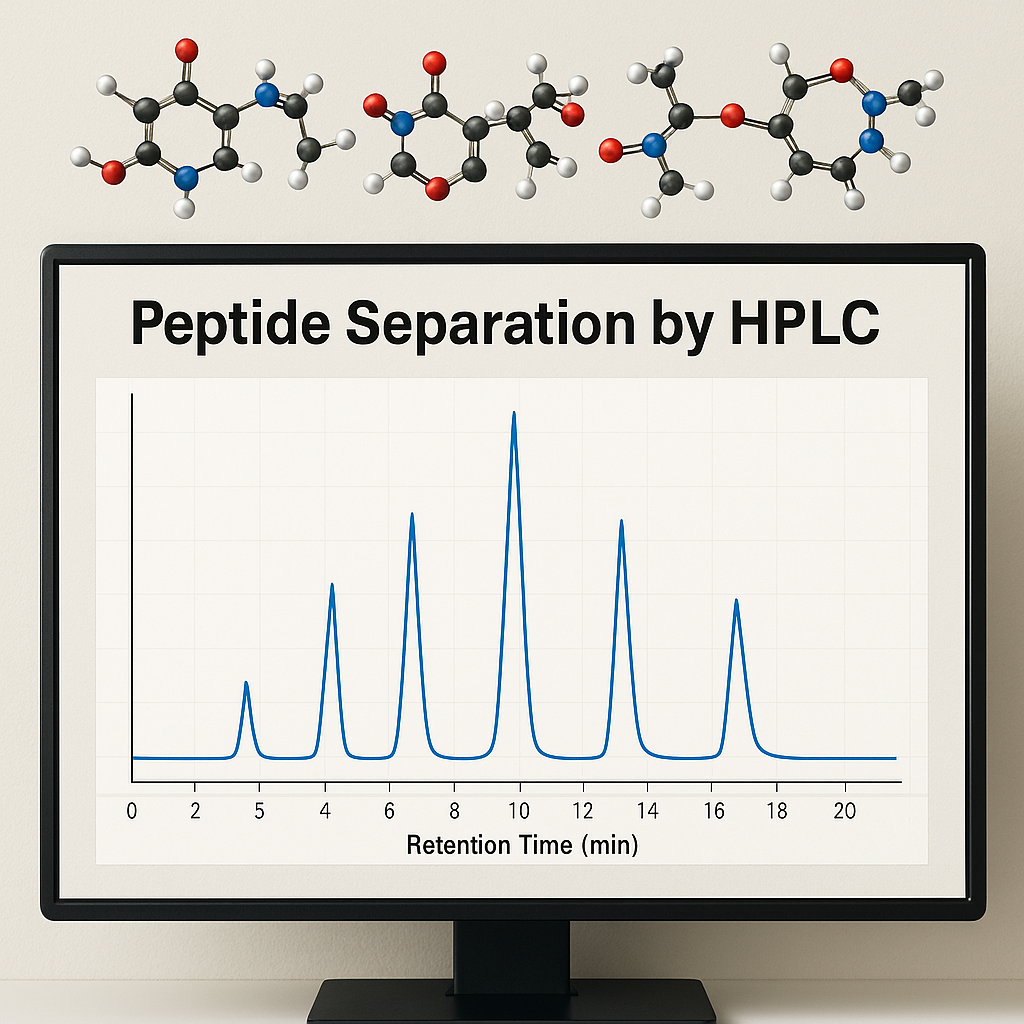
Peptide Purity Decision Innovative Peptides-peptide Medicine Exploration The chromatogram is one of the most essential visual data component on an HPLC peptide test report. It is a chart with time on the straight axis and detector reaction, generally UV absorbance, on the vertical axis. Each top represents a part that was divided and detected. Even small impurities can alter results, decrease reproducibility, or introduce unwanted variables right into a study. Scientists rely on precise, verified substances to guarantee their findings are both valid and consistent. While several firms specialise in peptide synthesis, Cernum supplies an elite level of documentation that straightens with the Peptide Purity needs of both independent biohackers and institutional scientists. It takes knowledge of formulation and threats integrated with developing certain analytical methods for every resources, basic material contamination, and so on to manage the final product top quality. Researchers after that determine just how much of the complete signal belongs to the main height. If 98% of the signal comes from the right peptide, the item is identified "98% pure by HPLC." This is a conventional means of revealing peptide quality across research and pharmaceutical industries. The study worth of any type of peptide compound depends directly on what is actually in the vial. A compound stated to be 95% pure consists of 5% of another thing-- and in a study setup, that "another thing" matters.
Eastern Logical Seminar Testimonial
Peptide screening is logical verification of a peptide sample. In COA evaluation, it typically consists of HPLC pureness testing, mass spectrometry identity confirmation, and batch-specific documentation showing the checked lot, method, results, and day. With years of logical screening experience and advanced instrument platforms, BOC Sciences gives detailed peptide top quality testing services across the whole procedure from basic materials to solutions. Third-party lab validation can greatly aid in this compliance procedure. The resulting information are formatted right into records that regulatory authorities expect.
Endotoxins
Health-focused applications involving shot create direct security ramifications from product top quality.May your tests remain accurate, your peptides remain pure, and your study remain validated.Also small impurities can modify results, minimize reproducibility, or introduce unwanted variables right into a research.Honest Peptide is not a worsening pharmacy or chemical compounding center as defined under area 503A of the Federal Food, Medicine, and Aesthetic Act, nor an outsourcing facility as defined under area 503B.In conclusion, recognizing peptide pureness degrees and qualities helps you make educated decisions for your experiments.
The most rigid quality, including cautious HPLC filtration-- often several rounds-- and extensive QC. Needed for measurable studies, structural biology, in vivo research study models, and any kind of application where even percentages of contamination can influence outcomes. This is the quality where the cost increases most greatly, due to the fact that attaining that last 1-- 3% of purity requires disposing of a substantial portion of the synthesized product. A useful assay determining downstream signaling-- or an architectural research using NMR or X-ray crystallography-- demands the highest purity readily available. Crystallographers in particular typically require ≥ 98% pureness since also small contaminants can stop crystal formation or present problem right into the crystal latticework. The reproducibility situation in biomedical research study is well-documented.
Is 95% pureness good for peptides?
Peptides with an 85% pureness degree or higher are generally used in enzyme assays or biological activity research studies. Peptides with purity higher than 95% are superb for measurable analysis.
MALDI-TOF (Matrix-Assisted Laser Desorption/Ionization Time-of-Flight) is quicker and easier. It generates predominantly single-charge ions, making ranges easier to interpret. MALDI-TOF is typically liked for regular identification confirmation due to its rate and resistance for sample impurities. Testing can expose underdosed items, weakened peptides, or outright fakes that discuss failed research. This information either validates product issues requiring supplier adjustment or rules out item high quality, routing fixing in other places. Notably, Finnrick uses cost-free testing for examples delivered to their Texas facility. They ask for HPLC as the key approach, measuring both identity and purity. Results are published on their platform, creating openness concerning vendor top quality with time. For a 10-residue peptide with 99.5% coupling effectiveness, you 'd expect about 95% of the end product to be the full-length sequence before purification. For a 30-residue peptide at the very same efficiency, that goes down to roughly 86%. This is why longer peptides are tougher to generate at high pureness and usually set you back even more. Browsing the landscape of where to buy research study peptides online calls for a concentrate on logical transparency and manufacturing roughness. While several systems work as basic suppliers, one of the most trustworthy entities preserve direct oversight of their synthesis and filtration pipelines. Whether you are conducting initial artificial insemination displays or intricate molecular modeling, selecting a supplier Research Materials with validated analytical requirements is paramount for reproducible outcomes.
Abbreviated Sequences (Removal Peptides)
Importantly, pureness portions describe chemical make-up just-- they do not suggest sterility or biological suitability. Peptides from Maxed Out Substances are provided exclusively for lab study usage and are not meant for human or vet purposes. The bottom line is not to puzzle purity (HPLC percentage of the major peptide vs pollutants) with total web content. For speculative planning (like determining molar concentrations), both purity and net content serve numbers, yet purity is what shows the chemical homogeneity of the peptide example. This relative data gives context past individual examination results. Net peptide content steps peptide versus every little thing else, consisting of water, salts, and counter-ions. A peptide can be 99% pure yet have only 70-80% net peptide material. Without independent confirmation, you're relying on marketing claims over scientific proof. And in the peptide world, that assumption can lead to lost cash, fell short research study, and potentially major security worries. You have actually bought peptides from what appeared like a reputable vendor. The product got here with a certificate of evaluation revealing 99% purity.